

























By J. L Andrew

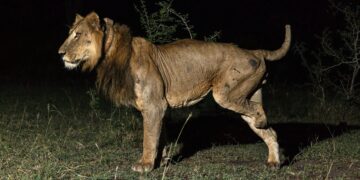
In a remarkable display of resilience, two male lions (bothers), one of them a three-legged survivor called Jacob, set a World record for the longest lion swim.
The incredible feat was captured on camera as they swam across the Kazinga Channel in Queen Elizabeth National Park in the Western part of Uganda within East Africa.
An aerial footage from a drone shows the two lions Tibu and Jacob bravely navigating the deep waters, which were approximately 20 feet deep, before successfully reaching the other side.
What truly stands out about this achievement, aside from the record-breaking swim, is the determination shown by Jacob, the three-legged lion, as he covered a distance of 1.5 kilometers.
This extraordinary event has left many in awe, prompting questions about the limits of Jacob’s endurance.
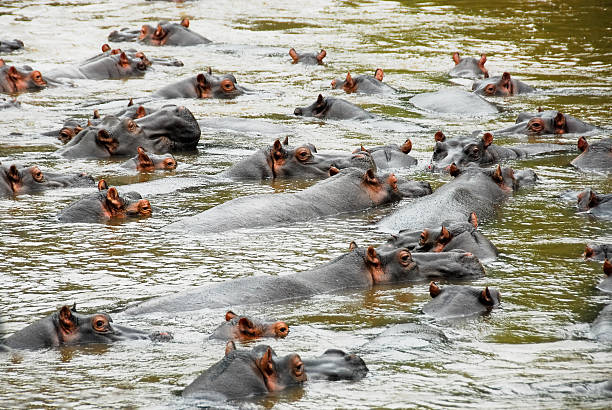
The 32km wide channel is also known to be a home of dangerous crocodiles and hippos.
The video captures the two lions quickly retreating to the shores twice, afraid of being attacked by the crocodiles. However, upon realizing the threat posed by another pride that had allegedly claimed the territory, they courageously decided to take their chances for the sake of survival.
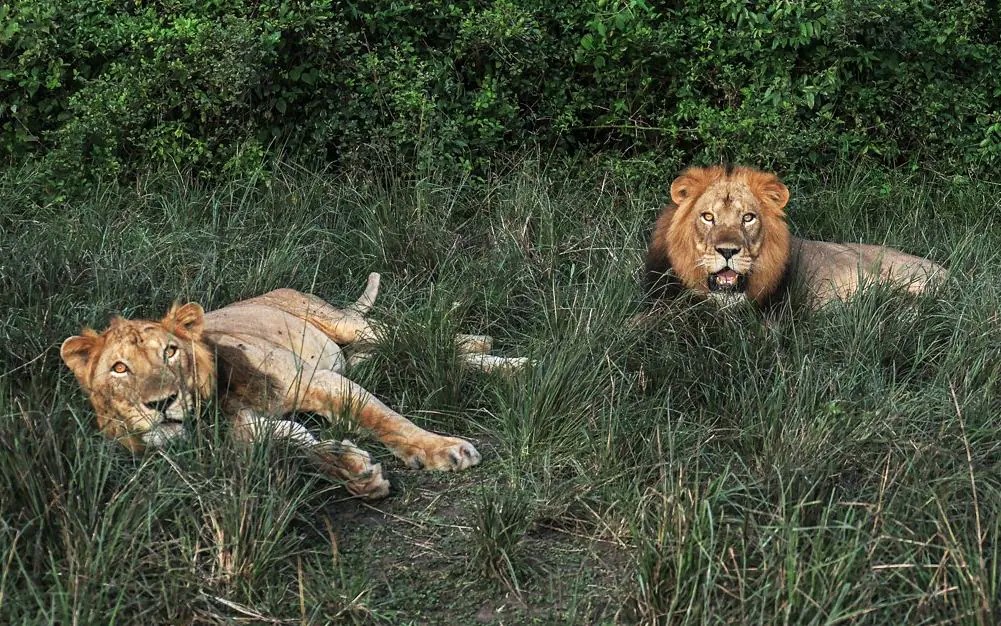
In the face of adversity, Jacob had to make a choice – either persevere alongside his brother or remain behind and face death from other lions.
It is alleged that earlier 12 hours before crossing, the two males had suffered a loss in a territorial dispute and were fortunate to have escaped with their lives.
It was perilous to remain on this side of the channel, and they could likely hear the distant roars of female lions on the other side across, which was also the safest place left for them.
The lions, like other cats such as leopards, and Cheetas among others, typically avoid water, but in this case, there was no alternative. This was their own luck!
This swin is considered the longest recorded lion swim, exceeding the previous record of 0.96 kilometers in Lake Kariba on the Zambia-Zimbabwe border.
Conservationists who have been observing the behavior of the two brothers reported that Jacob lost a portion of his left hind leg to a poacher’s trap in four years ago in 2020.
The scientists have outlined their results in a document that has been given the green light for publication in the journal Ecology and Evolution.
“It was pretty dramatic,” said Alexander Braczkowski, a conservation biologist working with Griffith University in Australia and Northern Arizona University who has been studying the lions since 2017.
“It looks like two tiny little heat signatures crossing an ocean,” he noted.
The Kazinga Channel divides the national park into two parts.
However, Dr. Braczkowski and his team claim they had observed Jacob and his brother on the opposite side of the channel three times, and had presumed that the lions had crossed the channel by swimming.
However, they did not have documented evidence of the lions swimming across the entire distance.
But lions have been observed swimming in the Okavango Delta in Botswana, but it is uncommon for them to swim beyond 150 feet, according to the New York Times.
The publication further claims that, in 2012, a lion was seen swimming approximately 330 feet across the Zambezi River, moving from Zimbabwe to Zambia, while in November 2023, another young male lion successfully swam across the Rufiji River in Southern Tanzania, covering a distance of up to 985 feet.
There are also reports suggesting that lions have swum from the shore of Lake Kariba (located on the border between Zambia and Zimbabwe) to one of the lake’s islands, a distance of 0.6 miles, although this has not been officially captured on video.
Large felines such as Tigers, Jaguars, Cougars, and Mountain Lions in regions of America, India, and certain parts of Africa have been filmed on Nat Geo Channel hunting caimans and other aquatic animals.
In 2022, research revealed that a mountain lion swam almost three-quarters of a mile in the Puget Sound near Washington State.
During that same year, a male tiger also covered a comparable distance while swimming across the Brahmaputra River in northern India.
Dr. Braczkowski calculated that the two lions in Uganda swam close to a mile across the Kazinga Channel.
Power for mating
Craig Packer, who managed the Serengeti Lion Project for 35 years and was not part of the research noted: “If there’s nobody to mate with, what are you doing? You’re a male lion. You don’t have a very long life span, so you have to get on with it, especially if you’re wounded.”
State of lions in Uganda
According to the spokesperson of Uganda Wildlife Authority, Bashir Hangi, the lion population in Uganda has decreased from approximately 460 in 2022 to around 310.
The 2021 State of Wild Resources in Uganda report indicates that as of 2020, only four out of the ten national parks in Uganda were home to lions.
These parks are Murchison Falls National Park with about 250 lions, Kidepo Valley National Park with 70 lions, Queen Elizabeth National Park with 52 lions, and Lake Mburo National Park with only one lion.
The report also highlights that only one lion was sighted in 2019 out of the estimated 15 lions in Semuliki National Park, which was not included in the census.
Additionally, the Uganda Wildlife Education Centre is home to 15 lions.















Leave a Reply