



















By Ramadhan Abbey

Tehran
Masoud Pezeshkian, the Iranian heart surgeon and reformist politician has been elected the President of the Islamic Republic of Iran
Pezeshkian becomes the 10th President of Iran after the Islamic Revolution. Others were Mohammad Makhber, the vice president who only served for 28 days after the death of President Ebrahim Raisi, Hassan Rouhani, Mahmoud Ahmadinejad, Muhammad Khatami, Akbar Hashem Rafsanjani, Ali Khamenei, Mohammad Ali Rajai and Abolhassan Banisadr.
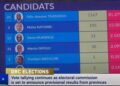
Pezeshkian, lawmaker who has been representing Tabriz, Osku and Azarshahr electoral district in the Parliament of Iran, won the presidential run-off with 53.7% ( 16.3m) votes ) over his Counterpart Saeed Jalili, ultraconservative, anti-Western and former nuclear negotiator ,who managed to secure only 44.3% (13.5m) of the votes cast on Friday .according the Ministry of Interior
“By gaining a majority of the votes cast on Friday, Pezeshkian has become Iran’s next president,” it said.
The participation was around 50% in a tight race between Pezeshkian, the sole moderate in the original field of four candidates, and hardline former nuclear negotiator Saeed Jalili, a staunch advocate of deepening ties with Russia and China.
Pezeshkian now replaces the late Ebrahim Raisi who died after helicopter they were travelling in had a “rough landing” in heavy fog in Dizmar forest, located near Jolfa, the Iranian City on the Borders of Azerbaijan Nakhchivan, around 600 kilometers (375 miles) Northwest of the Iranian Capital Tehran
Raisi 63 was on the state visit with the Azerbaijani president to discuss an infrastructure project over the Aras River, which separates Iran and Nakhchivan
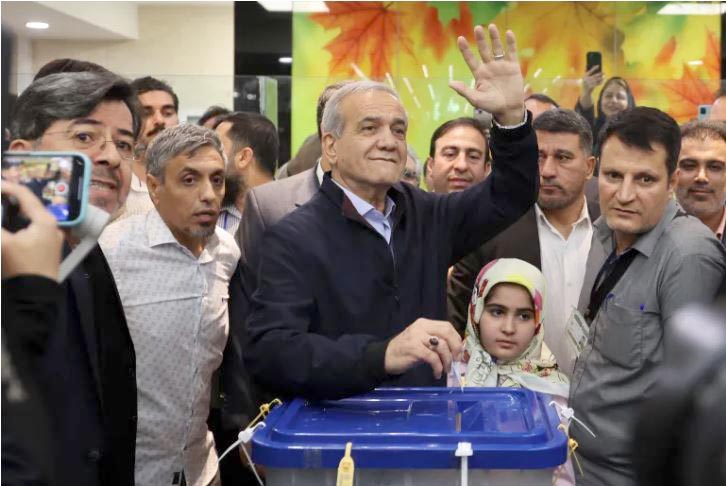
The run-off on Friday followed a June 28 ballot with historically low turnout where top candidates Pezeshkian and Jalili failed to secure the majority votes which is 50% plus one in a record low turn in presidential elections since the country’s 1979 revolution.
Although the country has 61 million eligible Iranians voters, only 40% voted last month.
Moderate Pezeshkian received more than 10.41 million votes from a total of more than 24.5 million ballots counted, followed by former nuclear negotiator Saeed Jalili with 9.47 million votes.
This is only the second time since the 1979 revolution that a presidential election has gone to a second round.
While the election is expected to have little impact on the Islamic Republic’s policies, the president will be closely involved in selecting the successor to Ayatollah Ali Khamenei, Iran’s 85-year-old Supreme Leader, who calls all the shots on top matters of state.
In his first public comments after the results were declared, Pezeshkian expressed gratitude to those who voted “with love and to help” the country.
“We will extend the hand of friendship to everyone … we are all people of this country … we should use everyone for the progress of the country,” he said on state television.
Pezeshkian’s supporters took to the streets of Tehran and other cities before dawn on Saturday to celebrate as his lead grew over Jalili, The Associated Press news agency reported.
Videos on social media showed his backers dancing in the streets in many cities and towns across the country and motorists honking car horns to cheer his victory.
The election coincides with escalating Middle East tensions due to the war between Israel and Iranian allies Hamas in Gaza and Hezbollah in Lebanon, as well as increased Western pressure on Iran over its fast-advancing uranium enrichment programme.
The next president is not expected to produce any major policy shift on the nuclear programme or change in support for militia groups across the Middle East, but he runs the government day-to-day and can influence the tone of Iran’s foreign and domestic policy
Who is Masoud Pezeshkian?
He is the only candidate who does not belong to the conservative or hardline factions and has been a member of parliament since 2008.
The five-time lawmaker, who represents Tabriz, was deputy parliament speaker from 2016 to 2020. A heart surgeon, he has also been a longtime member of the health commission of Iran’s parliament.
He was health minister in the early 2000s under former President Mohammad Khatami. He was disqualified from running in the 2021 presidential election by the Guardian Council.
His speeches during the campaign
While addressing supporters Pezeshkian called for “constructive relations” with Western governments to end Iran’s “isolation”, and has won endorsements from the moderate Rouhani and from reformist figures including ex-president Khatami.
“We can manage our country with unity and cohesion,” Pezeshkian told his cheering supporters.
“I will resolve internal disputes to the best of my ability,” he said.
Pezeshkian, who has vowed to “fully” oppose police patrols enforcing the mandatory headscarf and called to ease long-standing internet restrictions, was speaking before a crowd of women in colourful hijabs, mingled with others, draped in traditional black chadors, alongside men.
The hijab issue has become particularly contentious following mass protests following the 2022 death in custody of Mahsa Amini, detained for an alleged breach of the Islamic republic’s strict dress code for women.
Since the months-long nationwide unrest, women have increasingly flouted the code. But police in recent months have also toughened controls.












Leave a Reply