






















By Ramadhan Abbey

Tehran
Iran goes to poll today Friday July 5, 2024 in a presidential run-off to decide who will be Country’s next President between the moderate Masoud Pezeshkian against ultraconservative, anti-Western former nuclear negotiator Saeed Jalili.
The winner between Pezeshkian and Jalili will replace late Ebrahim Raisi who died after helicopter they were travelling in had a “rough landing” in heavy fog in Dizmar forest, located near Jolfa, the Iranian City on the Borders of Azerbaijan Nakhchivan, around 600 kilometers (375 miles) Northwest of the Iranian Capital Tehran
Raisi 63 was on the state visit with the Azerbaijani president to discuss an infrastructure project over the Aras River, which separates Iran and Nakhchivan
The run-off reflected in last month’s election June 28, 2024, where top candidates Pezeshkian and Jalili failed to secure the majority votes which is 50% plus one in a record low turn in presidential elections since the country’s 1979 revolution.
Although the country has 61 million eligible Iranians voters, only 40% voted last month .
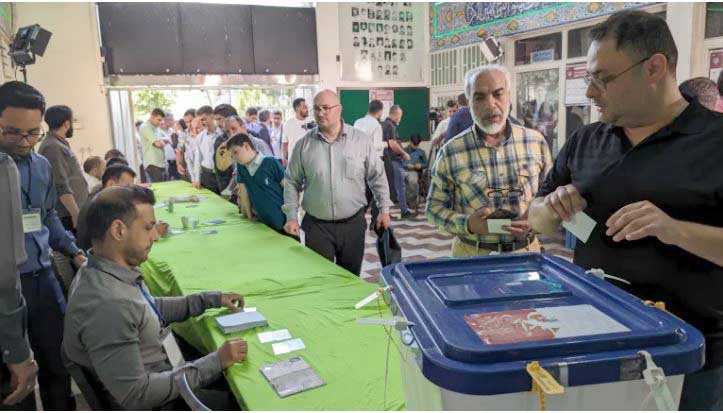
Moderate Pezeshkian received more than 10.41 million votes from a total of more than 24.5 million ballots counted, followed by former nuclear negotiator Saeed Jalili with 9.47 million votes.
This is only the second time since the 1979 revolution that a presidential election has gone to a second round.
Other candidates like Conservative Speaker of the Parliament Mohammad Bagher Ghalibaf, polled 3.38 million votes, and conservative Islamic leader Mostafa Pourmohammadi, with 206,397 votes, were knocked out of the race
. Two other candidates, Tehran Mayor Alireza Zakani and government official Amir-Hossein Ghazizadeh Hashemi got out of race a day to the election
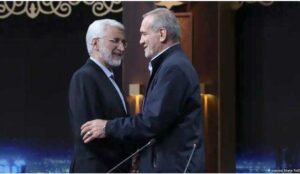
Ghalibaf, Zakani and Ghazizadeh called on their supporters to vote for Jalili in the run-off next Friday in order to ensure victory for the “revolution front”.
Who is Saeed Jalili?

Jalili is the direct representative of the supreme leader to the Supreme National Security Council (SNSC).
He was appointed by Khamenei as the secretary of the council in 2007, a post he held until 2013, during which time he handled the Iranian nuclear file.
He was replaced as security chief after a period of heightened tensions over Iran’s nuclear programme that led to international sanctions on the country.
The 58-year-old ran for president unsuccessfully against Hassan Rouhani in 2013, and in 2021 withdrew from a pool of seven candidates in favour of Raisi.
His longtime ally Ali Bagheri Kani , who has been Iran’s chief nuclear negotiator since 2021, is now acting foreign minister.
Jalili has remained in the SNSC, operating what he himself has proudly called a “shadow government”.
Jalili, is most famous for his uncompromising anti-West stance, has staunchly opposed moves to restore a landmark 2015 deal with world powers which imposed curbs on Iran’s nuclear activity in return for sanction relief.
He has argued that the deal, which collapsed in 2018 when the United States withdrew from it, had violated all of Iran’s “red lines” by allowing inspections of nuclear sites.
Jalili promised “strength and progress” if elected, as posters of the late ultraconservative Raisi adorned the walls, bearing the slogan: “A world of opportunities, Iran leaps forward.”
Who is Masoud Pezeshkian?

He is the only candidate who does not belong to the conservative or hardline factions and has been a member of parliament since 2008.
The five-time lawmaker, who represents Tabriz, was deputy parliament speaker from 2016 to 2020. A heart surgeon, he has also been a longtime member of the health commission of Iran’s parliament.
He was health minister in the early 2000s under former President Mohammad Khatami. He was disqualified from running in the 2021 presidential election by the Guardian Council.
While addressing supporters Pezeshkian called for “constructive relations” with Western governments to end Iran’s “isolation”, and has won endorsements from the moderate Rouhani and from reformist figures including ex-president Khatami.
“We can manage our country with unity and cohesion,” Pezeshkian told his cheering supporters.
“I will resolve internal disputes to the best of my ability,” he said.
Pezeshkian, who has vowed to “fully” oppose police patrols enforcing the mandatory headscarf and called to ease long-standing internet restrictions, was speaking before a crowd of women in colourful hijabs, mingled with others, draped in traditional black chadors, alongside men.
The hijab issue has become particularly contentious following mass protests following the 2022 death in custody of Mahsa Amini, detained for an alleged breach of the Islamic republic’s strict dress code for women.
Since the months-long nationwide unrest, women have increasingly flouted the code. But police in recent months have also toughened controls.














Leave a Reply